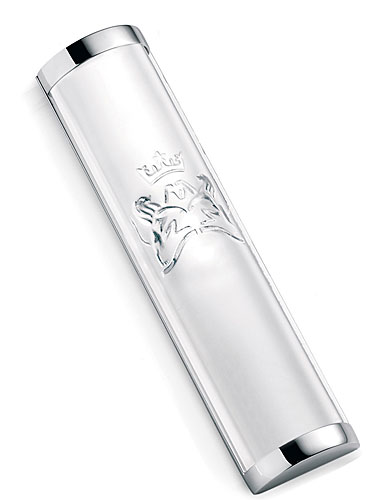
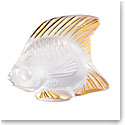
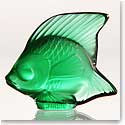
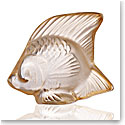
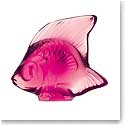
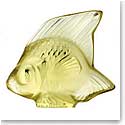
Lalique Mezuzah

$1,200

H: 5.39"

Gift Wrapping:

Item# 1202700

The Mezuzah signifies the sanctity and blessing of the Jewish home. The Torah tells us in Devarim 11:20-21 that the reward for keeping the mitzvah of mezuzah is long life for us and our children. In addition, we are taught that the mitzvah of mezuzah guards one's home from harm. Due to the holiness of the mezuzah and because the mezuzah represents our commitment to HaShem, the custom is to kiss the mezuzah whenever passing through a doorway.

The mezuzah case (with the scroll inside) should be affixed firmly to the upper third of the doorpost on the right hand side of the door as you enter the room, angled towards the inside of the house. Before attaching the mezuzah, a blessing is said "Blessed are you Adonai our G-d, sovereign of the universe, who makes us holy with the mitzvoth and commands us to affix a mezuzah ".

Note: A Mezuzah should be affixed to the doorpost of each room in the home and place of business (including basement, attic, and garage).


Back to Lalique | Home | View Cart
 

Add www.crystalclassics.com to your online bookmark site:
Add http://www.crystalclassics.com to your blinklist account Add http://www.crystalclassics.com to your delicious account Add http://www.crystalclassics.com to your digg account Add http://www.crystalclassics.com to your fark account Add http://www.crystalclassics.com to your furl accountAdd http://www.crystalclassics.com to your newsvine account Add http://www.crystalclassics.com to your reddit account Add http://www.crystalclassics.com to your simpy account Add http://www.crystalclassics.com to your spurl accountAdd http://www.crystalclassics.com to your shadows account Add http://www.crystalclassics.com to your sync2it account Monitor http://www.crystalclassics.com with Blogarithm Meneame

Be a Facebook fan of Crystal Classics


Crystal Classics is one of only a few authorized Lalique retailers online.

René Lalique became synonymous with French Art Nouveau decorative arts. René Lalique was born in 1860 and first began designing fine jewelry in Paris in 1881. Lalique pursued increasingly more innovative experimentation in glass commencing around 1883. Early works used the familiar "lost wax" technique by which the model is made in wax while a mold is formed around the model. Then, the wax is melted and molten glass is poured into the mold. Lalique glass was made in this manner until approximately 1905 at which time the factory was redesigned for a larger production. As such, the individual uniqueness of each example of Lalique glass came to an end with the end of the one-time only molding technique around wax models. The success of this venture resulted in the opening of his own glassworks at Combs-la-Ville in 1909. During the art nouveau period, Lalique was well known for a wide variety of objects including perfume bottles, vases, inkwells, decorative boxes, and bookends.

Lalique glass is lead based, either mold blown or pressed. Favored motifs during the Art Nouveau period were dancing nymphs, fish, dragonflies, and foliage. Characteristically the glass is crystal in combination with acid-etched relief. In addition to vases, clocks, automobile mascots, stemware, and bottles, many other useful objects were produced. While not well known, Lalique also experimented with bronze and other materials as well.

Waterford Crystal | Baccarat | Kosta Boda | Lalique | Marquis by Waterford | Mikasa | Miller Rogaska

Nambe | Nuance | Orrefors | Riedel | Royal Doulton | Swarovski | Schott Zwiesel | Vera Wang | Wedgwood

Customer Service | About Us | Gift Registry

(C) Crystal Classics. All Rights Reserved Worldwide